|
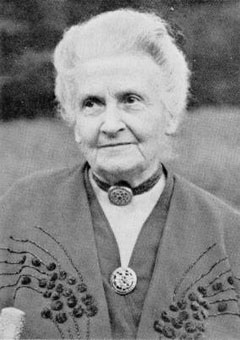 One of Italy’s first female physicians, Dr. Maria Montessori became interested in education while caring for children deemed by society as unreachable. In 1907, with the opening of Casa dei bambini (children’s house), Montessori continued to refine her educational method. Guided by her clinical understanding of children’s cognitive growth and development, Maria Montessori observed that young people learned best when engaged in purposeful activity rather than simply being fed information. Throughout her work, Montessori focused on the goal of education, rather than its methods. The goal of Montessori is to provide a stimulating, child-centered environment in which children can explore, touch, and learn without fear, thus creating a lifelong love of learning as well as providing the child the self-control necessary to fulfill that love. One of Italy’s first female physicians, Dr. Maria Montessori became interested in education while caring for children deemed by society as unreachable. In 1907, with the opening of Casa dei bambini (children’s house), Montessori continued to refine her educational method. Guided by her clinical understanding of children’s cognitive growth and development, Maria Montessori observed that young people learned best when engaged in purposeful activity rather than simply being fed information. Throughout her work, Montessori focused on the goal of education, rather than its methods. The goal of Montessori is to provide a stimulating, child-centered environment in which children can explore, touch, and learn without fear, thus creating a lifelong love of learning as well as providing the child the self-control necessary to fulfill that love.
As an educational method, the Montessori approach focuses on the individuality of each child. The Montessori method encourages independence and freedom within appropriate limits, which is always linked to responsibility. Activities in the classroom are called "works" to communicate the idea that work is positive and fulfilling. Every work is carefully selected and placed in the classroom with a specific purpose. These self-contained and self-correcting works introduce concepts that increase in complexity and abstraction as the child progresses through the years. Each child proceeds at his or her own pace from concrete objects and tactile experiences to abstract thinking, writing, reading, science, and mathematics. This systematic approach allows the child to concentrate and organize their knowledge and problems solving skills in a clear way.
Over the past 100 years, Montessori’s philosophy, materials and practices have spread around the globe and have been implemented in a variety of cultural settings.
|